Nothing Equal to It
My son sat through a dental procedure last week without a fuss. A few years ago a haircut took weeks of preparation and usually ended in screaming anyway. My wife and I were talking about this over tea yesterday evening, and somewhere in that conversation we realized we had crossed something. Nothing is finished; there is a long road still. But we had crossed something.
What struck me more than the progress was how it felt. A dental appointment is not an achievement. To most parents it is a line in the calendar. For us it was enormous, and the only reason it was enormous is that we had spent years on the other side of it. The difficulty is what gave the ordinary thing its weight. Had our son been neurotypical, that afternoon would have passed and neither of us would have noticed it at all.
That pushed me back toward a question I keep circling. People talk about peace as the thing to aim for, and I have never fully accepted it. The peace I usually see described is reached by subtraction. You withdraw from the noise, cut your attachments, sit somewhere quiet, and then report that you have found it. Anyone can be calm in an empty room. The harder question is whether you can live inside a marriage, a household, a child who needs you, the ordinary weight of work and money and time, and still find something worth calling joy. That seems to me the real test, and I have not passed it yet.
I would also like to work this out at a reasonable hour. At twenty-five you have not seen enough to hold an opinion worth having. At seventy-five the answer may finally arrive, but by then the question has stopped mattering. Forty feels like the age at which a person should at least know which direction he is facing. Whether that is possible I am not sure, because life keeps interrupting the effort. It knocks you down, treats you unfairly, and offers no explanation. I have found no consolation for that part. I am still looking.
What I have found is a line.
இடுக்கண் வருங்கால் நகுக அதனை
அடுத்தூர்வது அஃதொப்ப தில்.
Iṭukkaṇ varuṅkāl nakuka ataṉai
aṭuttūrvatu aḥtoppa til.
Thirukkural 621, from the chapter இடுக்கணழியாமை (iṭukkaṇ azhiyāmai), not breaking under adversity
The usual translation is mild: when trouble comes, laugh. Read that way it sounds like advice to keep your chin up, and it never held much for me. The words themselves are not mild.
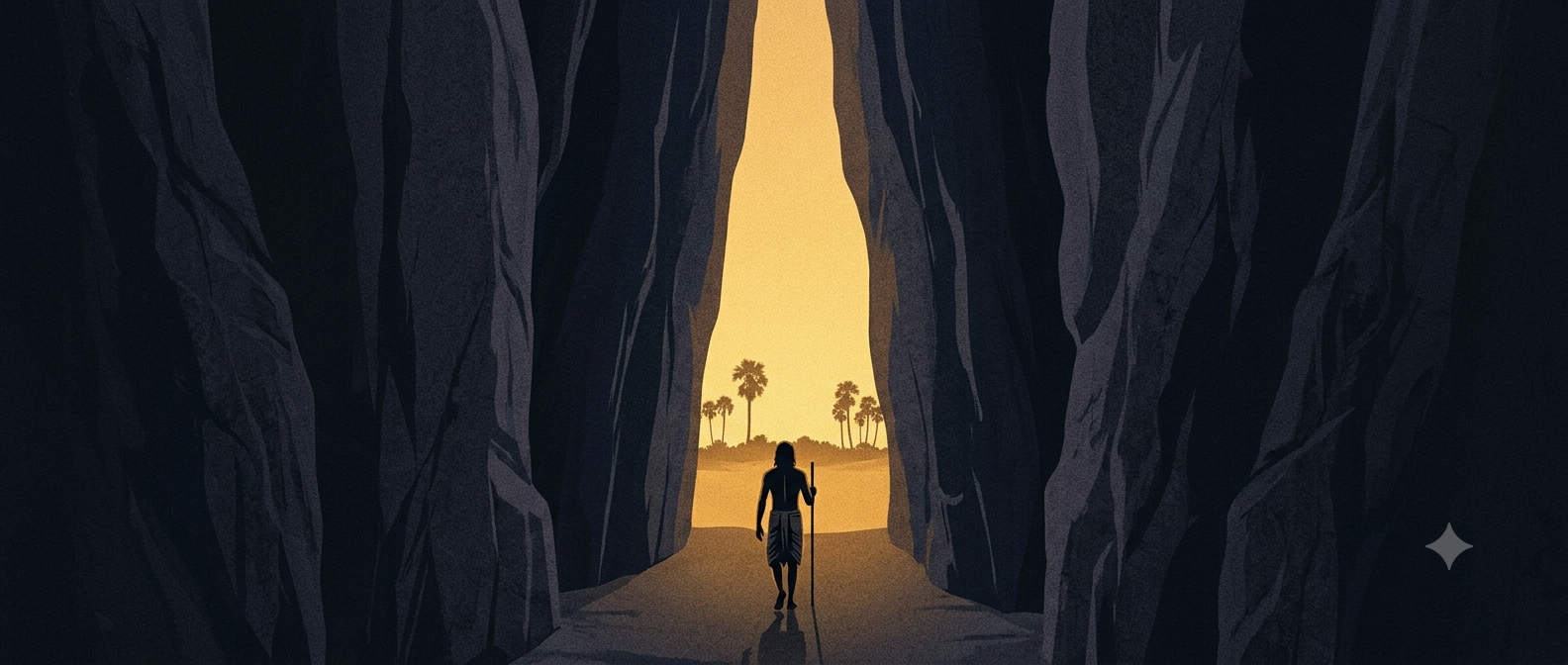
இடுக்கண் (iṭukkaṇ) is not a general word for sorrow. It is built from இடு (iṭu), meaning narrow or pinched, and கண் (kaṇ), meaning place or state. A constricted place. The condition of being cornered with nowhere left to move. நகு (naku) does not mean chuckle. In Sangam usage it is what light does, what a flower does when it opens, and what a warrior does on a battlefield when he wants the other man to understand he is not afraid. Then the second line turns. அடுத்து (aṭuttu) is the war word for pressing on an enemy without letting up. ஊர்வது (ūrvatu) is to mount and ride over, a chariot going across whatever is in its way. அஃதொப்பதில் (aḥtoppatil) means there is nothing equal to it.
So the Kural is not saying that laughter is a comfort while you endure. It is saying that going at the trouble, pressing it, riding over it, that there is nothing on earth comparable to it. The laughter is the opening move, not the consolation prize. You laugh because of what you are about to do to it.
That is the part that reached me. What my wife and I have is not endurance and it is not acceptance. Every one of those small wins, the haircut, and then years later a dentist’s chair, was something we went at and wore down. And there is no feeling I can set beside it. Not comfort, not calm, not any pleasure that arrived without being fought for. Nothing equal to it. Valluvar had already said so.
A life with only joy would leave you nothing to measure by. You would not recognize joy when it came, because nothing would stand against it. Nobody is offered that life anyway. What is actually on offer is the choice of how you meet trouble when it arrives, and the answer here is to meet it already smiling, because you know what is coming for it.
That is what my wife and I have been handed. It is what keeps me going.